
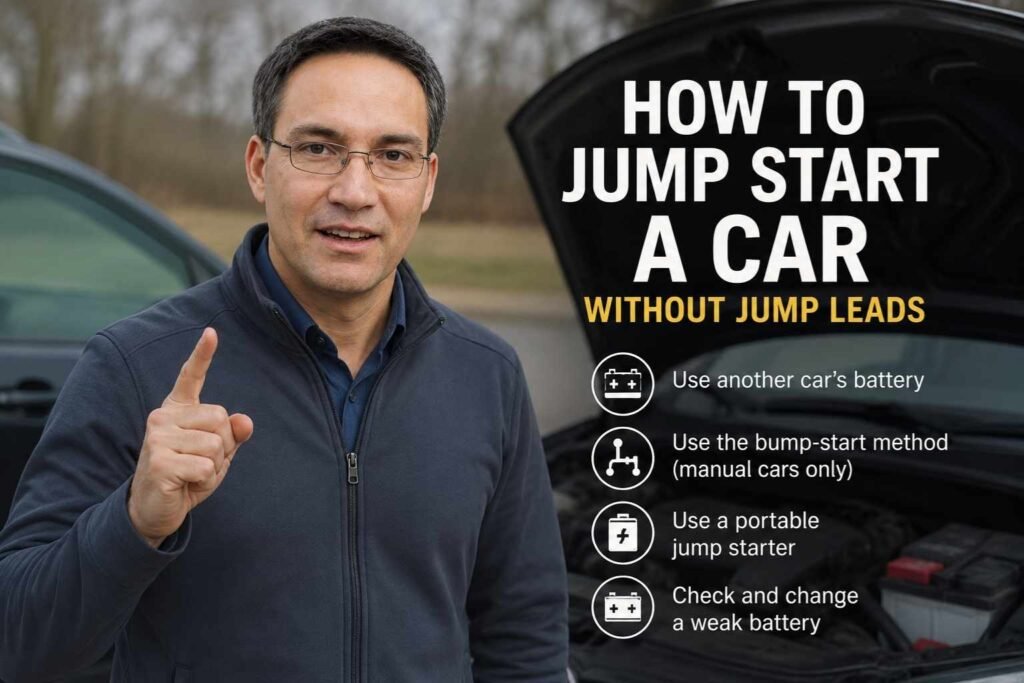
Stuck in a quiet lot with a dead battery is a total mood killer, especially if you have no cables in sight. I remember that same panic during a late-night grocery run until I learned how to jump start a car without jump leads using a few clever pro tricks. As the owner of AutoToolRadar and a long-time cook who loves road trips, I’ve mastered these hacks to keep my truck moving. Today, I’ll show you how to find your jump points and explain how many amps to jump start a car so you can get home safe. Let’s dive into these easy steps and get your engine humming again!
The Physics of the Dead Battery
Before you fix it, you must know why it died. Your battery is like a heart. Sometimes it just loses its beat.
In the US, our weather is wild. Maine is freezing. Arizona is a furnace. Both kill batteries fast. I once left a phone charger plugged into my Chevy. By morning, the battery was toast. That is “parasitic draw.” It happens to the best of us.
- Volts vs. Amps: Think of volts as water pressure. Amps are the flow.
- The Click: If you hear a rapid clicking, the battery has volts but no “push.”
- Heat vs. Cold: Cold slows the chemistry. Heat dries the liquid inside.
Master the Manual Push Start (The “Bump Start”)
This is my favorite trick. It feels like magic when the engine roars to life. It is great for manual cars like a Mustang or an old Jeep.
You are using the wheels to turn the engine. You skip the starter motor entirely. I did this once on a hill in San Francisco. It was scary but it worked! You need a bit of space and a friend to push.
Why Your Transmission Matters
You must have a manual gearbox for this. Modern automatics won’t let the wheels turn the engine this way. If you have a stick shift, you are in luck.
- Manual Gearbox: The clutch lets you “link” the wheels to the motor.
- Automatic Issues: Pushing an automatic in “Drive” does nothing for the engine.
- Electric Cars: Never try this with a Tesla or a Rivian.
The Step-by-Step “Pop”
First, find a flat spot. A small hill is even better. Gravity is your best friend here.
- Ignition On: Put the key in the “Run” spot. The dash lights should glow.
- Second Gear: Don’t use first gear. It is too jerky. Use second gear.
- The Push: Have your friends push the car from behind. Get some speed.
- The Drop: When you hit 5 mph, let the clutch out fast.
- Gas It: Give it a little gas as it sputters. It will cough, then roar!
The Modern Miracle: Portable Lithium Jump Starters
I don’t travel without one now. These are tiny boxes. They fit in your glove box next to your snacks. They hold a lot of power.
I used one last winter in Chicago. My neighbor’s Dodge was dead. I pulled out my small power pack. He laughed. He thought it was too small. Then, his engine started in one second. He stopped laughing then.
Choosing the Right Energy Density
Not all packs are the same. A big GMC Sierra needs more “oomph” than a small Fiat.
- Peak Amps: Look for a high number here. 1000A is a good start.
- USB Ports: Most can also charge your phone. That is a nice bonus.
- Flashlight: Most have a light. Trust me, you will need it at night.
Safety Features to Look For
You want a pack that is smart. You don’t want sparks or smoke.
- Reverse Polarity: This stops a fire if you flip the red and black clips.
- Spark-Proof: This keeps things calm when you touch the battery.
- Long Life: A good pack stays charged for months in your trunk.
How to Jump Start a Car Without Jump Leads Using a Power Bank
If you don’t have a car jump pack, look at your laptop charger. Some high-end banks can help. It is not a fast “jump.” It is a slow “soak.”
You are trying to move energy slowly. It is like filling a pool with a straw. It takes time. I tried this with a MacBook power bank once. It took twenty minutes, but the car finally turned over.
- The Wait: Let the bank sit connected for a long time.
- Check the Voltage: Make sure the bank is 12V or higher.
- Solid Connection: Use wires or even a metal coat hanger if you must.
The “Rope Trick” for Small Engines
This one is for the brave. It sounds like a movie trick. It works best on small 4-cylinder cars. I saw a guy do this with an old Toyota in a rural town.
You use a rope to spin the tire. The tire spins the engine. It is like starting a lawnmower. It is hard work, so get ready to sweat.
- Jack it Up: Lift one drive wheel off the ground.
- Gear Selection: Put the car in high gear, like 3rd or 4th.
- The Wrap: Wrap a strong rope around the tire.
- The Pull: Pull it as hard as you can. It might take a few tries!
Note : If you want to keep your car in top shape, you need expert help. I am the owner of AutoToolRadar. We specialize in high-quality tools and car service insights. If you ever feel stuck or need the best gear, come see us at AutoToolRadar. We make sure your car stays on the road, not the shoulder.
Understanding Your Car’s Electrical Anatomy
Your car is a computer on wheels. In the US, we love our tech. But tech needs power. If the voltage drops, the computer gets confused.
I once saw a BMW throw ten error codes. Why? Just a weak battery. The owner thought the engine was dying. It wasn’t. It just needed a steady flow of juice.
- The Alternator: This is your onboard power plant. It charges the battery as you drive.
- The Belt: If your belt squeaks, your battery might not be charging.
- Grounding: Electricity must flow back to the frame. Rust can block this.
Essential Gear for the Prepared American Driver
The US is huge. You might drive for hours without seeing a shop. Being ready is a must. I keep a “go-bag” in my trunk at all times.
You don’t need a lot of money. You just need the right tools. I trust brands like NOCO or Hulkman. They work when things get tough.
- A Multimeter: This tells you if a battery is truly dead or just weak.
- Terminal Brush: Clean those crusty white spots off your battery.
- Work Gloves: Don’t get battery acid on your skin. It stings!
Moving the Electrons: Physics and Tricks
Before we dive into the “how-to,” let’s chat about why your battery gave up. It isn’t just “dead”—it’s usually out of balance.
In my time working in a busy Chicago kitchen, I learned that timing is everything. Batteries are the same. In the U.S., our weather is a battery’s worst enemy. The deep freeze of a Minnesota winter or the soul-crushing heat of a Texas summer both drain the life from your car. I once left a tiny dome light on in my Chevy Silverado overnight. By 6 a.m., it was a brick. That’s “parasitic draw.” It’s a fancy way of saying your car is snacking on power while you sleep.
- Volts vs. Amps: Volts are like water pressure; Amps are the amount of water moving.
- The Rapid Click: That sound means you have volts (pressure) but no amps (flow) to push the starter.
- The Heat Factor: Hot weather evaporates the liquid inside your battery, killing it faster than cold ever will.
Master the Manual Push Start (The “Bump Start”)
This is the classic, old-school way to get moving. It’s perfect for stick-shift cars like a Mustang or an older Jeep Wrangler.
I remember doing this on a quiet street in Seattle. My friend and I looked ridiculous pushing a car in the rain, but when that engine roared to life, we felt like geniuses. You are essentially using the car’s weight and the road to “force” the engine to turn over, skipping the dead starter entirely.
Why Your Transmission Matters
You absolutely need a manual gearbox for this trick. Most modern automatic cars won’t let the engine and wheels connect this way while the car is off.
- Manual Gearbox: The clutch is your bridge. It connects the moving wheels to the engine.
- Automatic Issues: If you have an automatic Ford Explorer, this won’t work. You’ll just be pushing a heavy box for no reason.
- No EVs: Don’t try this with a Tesla. You’ll likely just damage the drive units.
The Step-by-Step “Pop”
First, find a clear path. A slight downhill grade is a lifesaver here.
- Ignition On: Put the key in the “Run” position so the fuel pump and dash stay alive.
- Second Gear Secret: Don’t use first gear; it’s too jerky. Second gear is much smoother for a jump.
- The Push: Have your buddies push from the back. Aim for about 5 to 10 mph.
- The Drop: Once you have speed, let the clutch out quickly.
- The Roar: The car will buck, and then—hopefully—the engine will fire up!
The Modern Miracle: Portable Lithium Jump Starters
I carry a portable pack in my glovebox now. They are small, about the size of a thick smartphone, and they are incredible.
Last winter, I helped a stranger at a Target parking lot. His Toyota RAV4 wouldn’t budge. I pulled out my lithium pack. He looked at it like it was a toy. Then, his car started instantly. He was shocked that something so small could kickstart a big engine.
Choosing the Right Energy Density
Not all packs are built the same. You need to match the pack to your engine size.
- Peak Amps: Look for at least 1000A if you drive a V6 or V8 engine.
- USB Ports: Most packs can charge your laptop or phone too. It’s a great backup for camping.
- Flashlight Mode: Most have a built-in LED. This is huge when you’re under a hood at night.
Safety Features to Look For
You want a pack that is “dummy-proof.” Trust me, when you are stressed and it’s dark, you might make a mistake.
- Reverse Polarity Protection: This stops a fire if you put red on black by accident.
- Spark-Proof Tech: This keeps things quiet when you touch the terminals.
- Long-Term Charge: Good packs stay ready for 6–12 months in your trunk.
How to Jump Start a Car Without Jump Leads Using a Power Bank
If you don’t have a car-specific jump pack, you might have a laptop power bank. This is a slow, patient method.
You aren’t “jumping” the car. You are slowly trickling power back into the battery. It’s like filling a bucket with a leaky faucet. I once used a MacBook power bank to help a friend. It took about 25 minutes of sitting there, but it gave the battery just enough “surface charge” to crank the engine once.
- The Wait Time: You need to leave it connected for at least 20–30 minutes.
- Voltage Matching: Ensure your power bank is rated for 12V output.
- Emergency Wires: If you don’t have clips, you can use thick copper wire in a pinch.
Expert Advice from AutoToolRadar: If you find yourself constantly needing a jump, your battery or alternator might be failing. I’m the owner of AutoToolRadar, and we see this all the time. Don’t wait until you’re stranded in the middle of nowhere. Get your car serviced at AutoToolRadar. We use the best diagnostic tools to make sure your electrical system is healthy and ready for any road trip.
The “Rope Trick” for Small Engines
This is a wild one. It’s a bit dangerous and should only be a last resort. It works best on small, 4-cylinder engines.
I saw a guy do this with an old Honda Civic once. He jacked up the front wheel, wrapped a tow strap around the tire, and pulled. It looked like he was starting a giant lawnmower. It worked, but it took a lot of muscle and three tries.
- Jack it Up: You must lift the drive wheel (usually the front) off the ground.
- High Gear: Put the car in 3rd or 4th gear.
- The Big Pull: Pull the rope toward the front of the car as hard as you can.
- Safety First: Be very careful. That tire will spin fast once the engine starts!
Understanding Your Car’s Electrical Anatomy
Modern cars are basically rolling computers. In the U.S., we love our luxury features, but they all eat electricity.
If your battery gets weak, your car might act possessed. I’ve seen BMW dashboards light up like a Christmas tree just because the battery was at 11 volts instead of 12. It’s not a mechanical failure; it’s just a “brain freeze” from low power.
- The Alternator: This is your car’s generator. It recharges the battery while the engine runs.
- The Belt: If you hear a high-pitched squeal, your alternator belt might be slipping.
- Ground Points: Electricity must loop back to the car’s frame. A loose bolt can ruin everything.
The Drill Battery Hack: Power in Your Hand
I remember a time when I was filming a car review in the middle of a dusty trail. My camera gear was ready, but my truck was dead. I looked at my cordless drill and had a wild thought. Could I use this battery to start my car?
It turns out, you can! This is a great tip for any US driver who loves DIY projects. Most drill batteries are 18V or 20V. Your car battery is 12V. You have to be very careful not to fry your car’s brain. But in a pinch, it can save your life.
- The Bridge: Use two long screws or bits of wire to touch the drill battery terminals.
- Wait and See: Don’t try to start it right away. Let the drill battery “talk” to the car battery for 10 minutes.
- The Spark: If you see big sparks, stop! You don’t want a fire in your engine bay.
Cleaning Terminals with Household Items
Sometimes your battery isn’t dead. It’s just dirty. I see this a lot on high-mileage cars in the South where humidity is high.
I once helped a lady at a gas station. Her car wouldn’t start. I saw blue “fuzz” on her battery. I didn’t have a brush. I used a can of Coca-Cola. The acid in the soda ate the corrosion right off. It’s a messy trick, but it works in a real emergency!
- Baking Soda Mix: A better way is mixing baking soda with a little water.
- The Scrub: Use an old toothbrush. Scrub until the metal looks shiny and new.
- Petroleum Jelly: Once clean, dab a little jelly on top. It stops the fuzz from coming back.
Managing the “Click of Death”
If you turn your key and hear click-click-click, your battery is very low. This is the sound of the starter solenoid failing to engage.
In my years as a motoring journalist, I’ve heard this sound more times than I can count. It’s the sound of a bad morning. If you hear this, stop turning the key. You are just wasting the tiny bit of power you have left.
- Turn Off Everything: Shut off the AC, the radio, and the lights. Give the battery a break.
- The Tap: Sometimes, tapping the starter with a wrench can unstick it. It’s an old-timer trick that still works.
- Wait 5 Minutes: Let the battery rest. Sometimes it “recovers” just enough for one last try.
Why US Drivers Should Care About Battery Chemistry
We drive long distances in the States. A road trip from NYC to LA is no joke. Your battery is under a lot of stress the whole time.
Most cars use lead-acid batteries. They are heavy and cheap. But newer cars like Ford and GM models now use AGM (Absorbent Glass Mat) batteries. They handle vibration better. They also last longer in the cold winters of the Midwest.
- Standard Lead-Acid: Good for older cars. Cheap and easy to find at any AutoZone.
- AGM Batteries: Great for cars with “Start-Stop” tech. They charge faster.
- Lithium-Ion: Mostly found in EVs and hybrids. Do not try to jump these like a normal car!
Trust the Experts at AutoToolRadar: Don’t let a “clicking” starter ruin your week. At AutoToolRadar, we have the latest testing gear to see if your battery is dying or if your alternator is the real thief. We love cars as much as you do. Swing by AutoToolRadar for a quick health check. We keep you on the road and out of the shop.
Using Solar Power as a Backup
If you are a car influencer like me, you probably spend a lot of time in the sun. Why not use it to charge your car?
Solar trickle chargers are becoming popular in the US. You can put a small panel on your dash. It plugs into your cigarette lighter. It won’t “jump” a car in a second. But if you are camping for a week, it keeps your battery full and happy.
- Dashboard Panels: These are small and catch the sun through the glass.
- Direct Connection: Some panels clip right to the battery under the hood.
- Weather Proof: Make sure your gear can handle a sudden rainstorm!
The Roadside Assistance Safety Net
Sometimes, DIY isn’t enough. I have had to call for help even with all my tools. There is no shame in it.
If your battery case is bulging or leaking, do not touch it. That is acid. It will burn you. In this case, calling a pro is the only smart move. In the US, services like AAA or your insurance’s roadside help are great for this.
- Look for Leaks: If you see liquid, stay back.
- Smell for Eggs: A sulfur smell means the battery is overcharging and dangerous.
- Professional Tow: Sometimes a jump won’t work because the starter is dead. Then you need a lift.
Choosing the Best Replacement Battery
If your battery is more than 3 years old, it’s probably time to say goodbye. I have tested many brands over the years.
In 2026, we have some great options. Exide and Bosch are still the kings of reliability. If you drive a luxury car like a Cadillac, stick with the high-end AGM models. They handle the extra screens and sensors much better.
- AC Delco: A solid choice for Chevy and GMC owners.
- Varta: Excellent for European cars like VW or Audi.
- DieHard: A classic US brand that still delivers great cranking power.
Final Thoughts on Car Survival
Learning how to jump start a car without jump leads is a superpower. It turns a disaster into a story you tell your friends.
I’ve been stuck in the cold. I’ve been stuck in the desert. Every time, a little bit of knowledge was the key to getting home. Keep a small jump pack in your car. Keep your terminals clean. And most of all, listen to your car. It usually tells you when it’s feeling weak.
- Be Patient: These tricks take time. Don’t rush and break something.
- Be Safe: Always watch for moving parts and hot engines.
- Be Ready: A little prep goes a long way on the American highway.
Final Word from AutoToolRadar: I built AutoToolRadar because I love helping people understand their machines. Whether you need a new tool or just a bit of advice, we are here for you. Don’t be a stranger. Visit AutoToolRadar today and let’s make sure your car is as ready for the road as you are!

I’m William James, the founder and owner of Auto Tool Radar. My journey didn’t start in a boardroom; it started in my father’s garage in Bellingham, Washington, where I spent my childhood figuring out not just how to fix engines, but why they failed in the first place.
With a Master’s in Automotive Engineering and years of experience as a diagnostic engineer, I saw firsthand how much the industry struggled with outdated tools and guesswork. I founded Auto Tool Radar in 2015 to change that. My philosophy is simple: technology should empower technicians, not complicate their lives. Whether we’re handling precision brake repairs or implementing AI-driven diagnostics, my goal is to provide the reliability and data-driven insights that modern drivers and professionals deserve.