
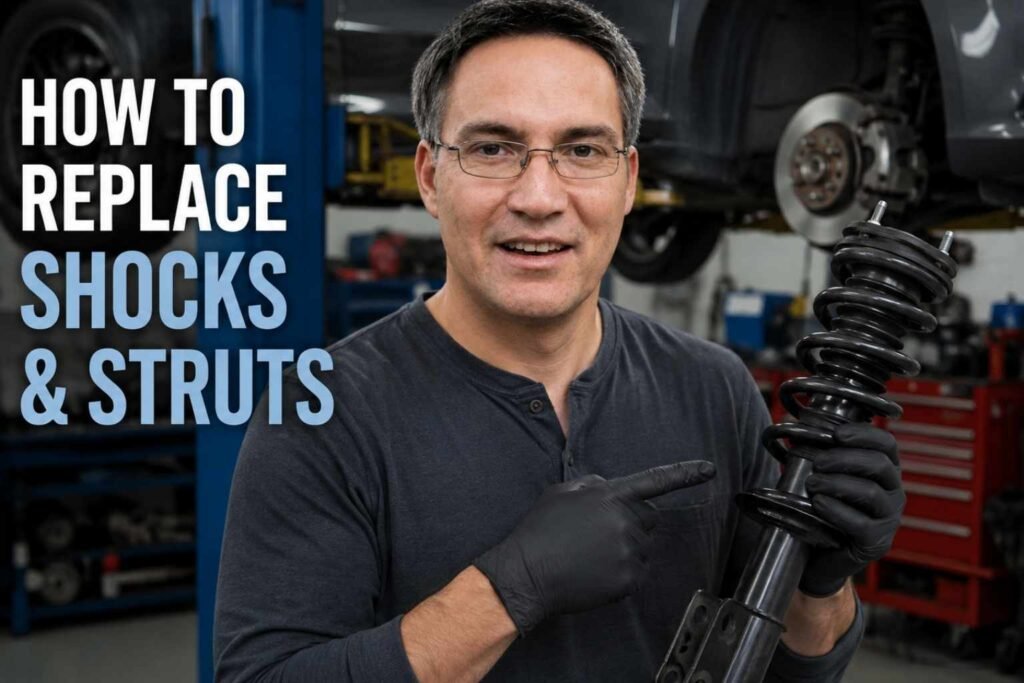
I’ve spent years under car lifts. I’ve worked in dusty Detroit garages and under the bright lights of SEMA. One thing is certain. Your suspension is the unsung hero of your daily commute. If your Ford F-150 feels like a bouncy castle, it is time to talk. If your Toyota Camry dives every time you hit the brakes, you have a problem.
Knowing how to replace a shocks and struts isn’t just a weekend project. It’s about reclaiming that “new car” feel. It keeps you safe on the interstate. I remember the first time I did this on my old Jeep. I was nervous. My hands were greasy. But when I finished, the ride was smooth as silk. You can do this too.
Why Your Suspension is Screaming for Help
Your car talks to you through your seat and the steering wheel. If the ride feels “off,” it usually means your dampers have checked out for early retirement. I once drove a buddy’s Chevy Silverado that bounced for three blocks after hitting one tiny pothole. We called it the “Boat Effect.” It was funny until we realized how dangerous it was and started looking into how much it costs to replace shocks and struts.
If you’re planning a DIY fix or a trip to the shop, it helps to know how long it takes to replace struts and shocks so you can clear your afternoon.
- The “Boat” Effect: Does your car bounce three times after a bump? That is a clear sign.
- Visual Leakage: Look for wet, oily spots on the shock body. This is hydraulic fluid escaping.
- Tire Cupping: Look for uneven, wavy wear on your tread. It looks like little scoops were taken out.
- The Nose Dive: Does your front end dip hard when you hit the brakes at a red light? That’s poor weight transfer.
Pre-Game: Tools You Actually Need
You need the right gear before you crack a beer or a bolt. Using the wrong tool turns a two-hour job into a three-day nightmare.
I’ve learned the hard way that a cheap wrench will round off a bolt faster than you can blink. Don’t be like me. Get the good stuff.
The Essential Toolbox
- Metric and SAE Sockets: American and Import cars use different sizes. Have both ready.
- The Breaker Bar: This is your best friend for rusted, stubborn bolts. It gives you leverage.
- Torque Wrench: This is crucial for safety. Never just “guess” how tight a suspension bolt is.
- Jack Stands and Floor Jack: Never work under a car held only by a jack. It can fail. Use stands.
Specialized Gear for the Job
- Spring Compressors: These are the most “exciting” tools. They hold back a lot of energy.
- Penetrating Oil: Spray this on your bolts 24 hours early. PB Blaster is a lifaker.
- Rubber Mallet: Sometimes things just need a little “nudge” to come loose.
Choosing the Right Parts for the American Road
Not all dampers are made the same way. Picking the wrong ones can turn your smooth ride into a stiff lumber wagon.
Think about where you drive. Are you hitting the open highways of Texas? Or are you dodging potholes in Chicago? Your choice of parts matters for your back and your car.
Shocks vs. Struts: What’s the Difference?
Many people use these terms as the same thing. They are not. A shock absorber is a simple damper. You find them on the back of trucks like the Ram 1500.
A strut is more complex. It is a structural part of the suspension. It often holds the coil spring and supports the weight of the car. If you have a strut, you usually need an alignment after you change it.
Loaded Strut Assemblies (The Pro Secret)
I always recommend “Loaded Struts” or “Quick-Struts.” These come with the spring already installed. You don’t have to use a spring compressor.
It saves so much time. It is much safer for a DIYer. Spend the extra $50. Your sanity is worth way more than that.
Step-by-Step: How to Replace Shocks and Struts
This is where the grease meets your fingernails. We are going to walk through the physical labor of the teardown.
I usually start on a Saturday morning. I put on some music and take my time. Don’t rush this. If you feel frustrated, walk away for five minutes.
Preparation and Safety
First, park on a flat surface. Loosen the lug nuts while the tires are still on the ground. Lift the car and place it firmly on jack stands.
Give the car a good shake. If it moves, adjust the stands. You want to be 100% sure it won’t fall while you are underneath it.
The Front Strut Removal
Start by disconnecting the sway bar link. These are often the most annoying bolts. They like to spin in circles. You might need a pair of pliers to hold the back.
Next, unbolt the knuckle from the bottom of the strut. Use a marker to trace around the bolts. This helps you get the alignment close when you put it back together.
Managing the Coil Spring
If you aren’t using a loaded assembly, you must compress the spring. Treat a compressed spring like a loaded weapon. It has enough power to cause serious harm.
Tighten the compressors evenly on both sides. Once the spring is loose, you can take the top nut off. Switch the parts over to the new strut body.
Getting Expert Help in Washington
If this sounds like a bit much, don’t sweat it. I love doing this work, but I know not everyone has the time or the tools.
If you are in the Pacific Northwest, come see us. I am the owner of AutoToolRadar. We specialize in keeping your ride smooth and safe.
- Location: 4030 Cordata Parkway, Bellingham, WA
- Phone: +1 564-233-9039
We can handle the heavy lifting for you. We see a lot of rusted suspension parts here in Washington. We have the torches and the pro tools to get it done fast.
Rear Shock Replacement: The Easy Win
Most rear shocks are much simpler than the front struts. They usually stand alone without a heavy coil spring wrapped around them.
I remember helping a neighbor with his Ford Explorer last fall. The rear end was sagging and swaying on the highway. We swapped both rear shocks in under forty minutes. It’s the perfect “confidence booster” if you’re new to wrenching.
- Access the Mounts: Some top bolts are inside the trunk. Others are tucked up in the wheel well.
- The “Jack-Assist” Trick: New shocks are stiff. Use your floor jack to slowly compress the shock so the bolt holes line up.
- Order of Operations: Always install the top bolt loosely first. Then, pivot the bottom into place.
- Bushings Matter: Make sure the rubber bushings are seated flat. If they are crooked, they will squeak and wear out fast.
Post-Installation: The “Don’t Skip This” List
The heavy lifting is done, but you aren’t ready for the road yet. You need to verify your work to ensure everything stays tight.
I once forgot to do a final torque check on a sway bar link. Every time I hit a pebble, it sounded like a hammer hitting a tin can. It’s a mistake you only want to make once.
The Final Torque Check
Wait until the car is back on the ground. The weight of the vehicle needs to be on the suspension. This is called “Ride Height.”
If you tighten the bolts while the wheels are hanging in the air, you can tear the new rubber bushings. Get under there with your torque wrench and click every bolt to the factory spec.
Why You Need an Alignment
Replacing struts changes the angle of your tires. Even if you marked the bolts, it won’t be perfect. If you skip the alignment, you will ruin your expensive tires in a few months.
Think of it as insurance. You just spent money on new struts. Spend a little more to make sure your car drives straight as an arrow.
Common Pitfalls and Troubleshooting
Sometimes you finish the job, and things still don’t feel right. Don’t panic. Most “new” noises are simple fixes.
I’ve had days where I dropped a bolt into the subframe. I’ve had days where I realized I put a washer on backward. It happens to the best of us.
- The Mystery Clunk: Check the top nut on the strut tower. It often needs one last turn once the car is on the ground.
- The “Crunchy” Steering: This usually means the upper strut bearing wasn’t greased or seated correctly.
- Stiff Ride: If the car feels like a brick, give it a week. New shocks often have a “break-in” period of about 500 miles.
Making Your Suspension Last
In the US, we deal with everything from salt in the North to extreme heat in the South. These elements are the enemies of your rubber seals.
I like to spray my suspension down with a hose once a month. This is especially true if you live in the “Salt Belt.” Keeping the grit off the piston rods prevents leaks.
- Avoid Overloading: If you’re hauling heavy gear in your SUV, don’t exceed the weight limit. It kills the valving inside the shock.
- Watch the Potholes: It sounds simple, but hitting a crater at 60 mph can bend a brand-new strut instantly.
- Check the Boots: If the plastic dust boot is torn, replace it. It keeps dirt from scratching the smooth metal rod.
Final Thoughts from the Garage
Learning how to replace shocks and struts is a rite of passage for any car lover. It connects you to your machine. You’ll feel every turn and every stop more clearly.
If you get stuck, or if you just don’t want to deal with rusted bolts in the rain, give us a shout. I built AutoToolRadar to help folks exactly like you. We are located right here in Bellingham.
Visit Us: 4030 Cordata Parkway, Bellingham, WA Call Me: +1 564-233-9039
We have the professional gear to handle the toughest jobs. Whether you need a full suspension overhaul or just a quick safety check, we’ve got your back. Stay safe out there and enjoy the smooth ride!

I’m William James, the founder and owner of Auto Tool Radar. My journey didn’t start in a boardroom; it started in my father’s garage in Bellingham, Washington, where I spent my childhood figuring out not just how to fix engines, but why they failed in the first place.
With a Master’s in Automotive Engineering and years of experience as a diagnostic engineer, I saw firsthand how much the industry struggled with outdated tools and guesswork. I founded Auto Tool Radar in 2015 to change that. My philosophy is simple: technology should empower technicians, not complicate their lives. Whether we’re handling precision brake repairs or implementing AI-driven diagnostics, my goal is to provide the reliability and data-driven insights that modern drivers and professionals deserve.