
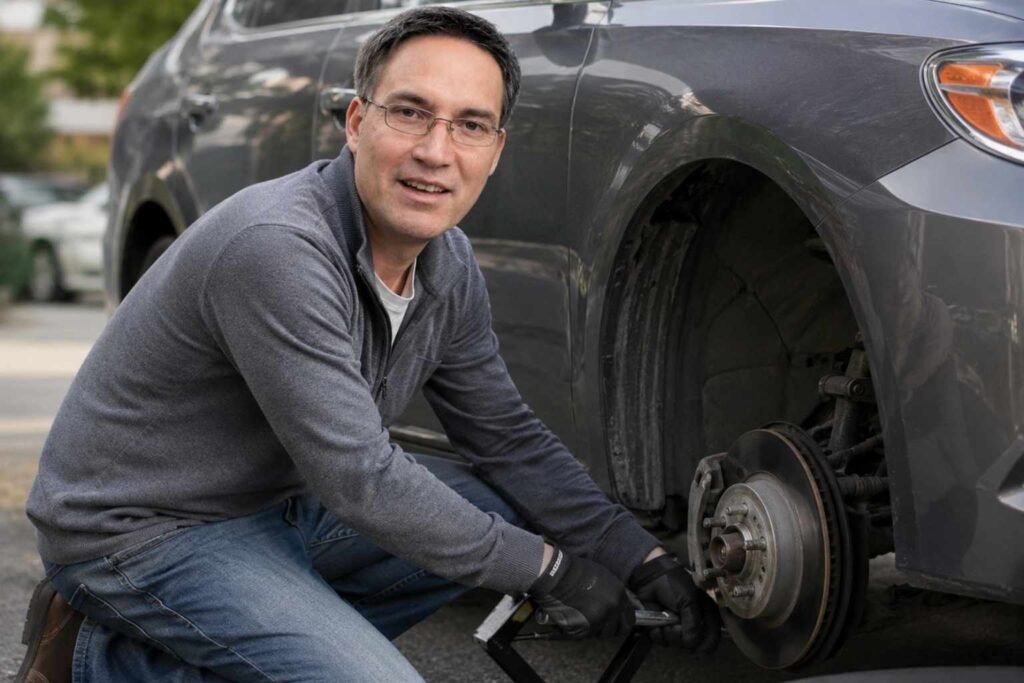
Stuck on the side of the road with a flat? I’ve been there, and I know how scary it feels when you don’t know how to change car tire steps. Since that rainy night I got stranded, I’ve mastered the process to help you stay safe and confident. This guide breaks down the simple tools you need and the quick steps to get back on the road. Read on to learn this vital skill and see how long do tires last on a car so you can avoid future flats!
Finding Your Safe Zone in the Chaos
Before you grab a tool, you must think about where you are. Safety is your first job.
The roadside is a dangerous place if you are not careful. You need space to move and a firm surface to lift your car safely.
- Look for Level Ground: Never jack up a car on a hill. It can slip and crush the rotor or, worse, you.
- Get Off the Road: Pull as far onto the shoulder as you can. If you can find a parking lot, even better.
- Lights On: Hit that hazard button. In the US, drivers can be distracted. You want to look like a Christmas tree.
- The Brake: Pull your parking brake hard. You do not want the car rolling while it is up in the air.
I remember my hands were shaking just a little. Not from fear, but from the adrenaline of the situation. I used a heavy rock I found nearby as a wheel chock. It wasn’t fancy, but it worked.
Opening the Treasure Chest: Your Trunk Tools
Every car has a hidden kit. Usually, it is under the floor mat in your trunk or hatch.
Knowing what tools you have is half the battle. Most factory kits are basic, but they get the job done in a pinch.
- The Jack: This is the heavy metal device that lifts the car.
- The Lug Wrench: This is the tool that turns the bolts on your wheel.
- The Spare: Most US cars have a “donut” or a full-size spare. Check yours often.
- The Owner’s Manual: If you get stuck, this book is your best friend.
I pulled out my wrench. It felt cold and greasy. I always suggest keeping a pair of work gloves in your trunk. My hands were covered in brake dust within two minutes. It’s a messy job, but someone has to do it.
If you find your tools are rusted or missing, come see us at AutoToolRadar. I own the place, and we make sure your emergency kit is actually ready for an emergency. We check the stuff the big shops ignore.
Breaking the Seal: Loosening the Bolts
This is the part that requires a bit of muscle. You have to be smarter than the bolt.
You must loosen the nuts before you lift the car. If the tire is in the air, it will just spin when you try to turn the wrench.
- Righty Tightly, Lefty Loosey: Turn the wrench counter-clockwise to loosen.
- Use Your Weight: If the bolt is stuck, stand on the wrench. I’ve had to jump on mine before.
- Don’t Take Them Off: Just crack them loose. You want them to stay on until the car is up.
- Watch Your Back: Keep your spine straight. Push with your legs.
I once saw a guy try to do this after jacking the car up. The whole car wobbled. It was a disaster waiting to happen. I learned that lesson early in my career as a motoring journalist.
Specific US brands like Jeep or Ram often have very tight bolts from the factory. You might need a bit more “oomph” for those. It’s a great workout, though I’d prefer the gym over the highway any day.
The Big Lift: Using the Jack Correcty
Now comes the part that makes people nervous. Lifting a two-ton machine.
You have to find the “jack point.” This is a reinforced part of the frame meant to hold the weight.
- Look for the Notch: Most cars have a small mark or a flat metal rail under the doors.
- Slow and Steady: Turn the jack handle slowly. Watch the car rise.
- Clearance: You only need enough space to get the flat tire off and the full one on.
- Stability Check: Give the car a very tiny nudge. If it feels solid, keep going.
I watched the frame of my car rise. The springs groaned. It’s a sensory experience—the smell of hot rubber and the sound of metal clicking. I always feel a sense of pride when the tire finally leaves the ground.
At AutoToolRadar, we often see cars with damaged side skirts because people jacked them up in the wrong spot. Don’t be that person. If you aren’t sure where your jack points are, stop by and let us show you. It’s better to ask than to dent your floorboards.
The Swap: Out with the Old, In with the New
Once the car is up, the real work of swapping the wheels begins. It is a simple swap, but you have to be careful with your fingers and the wheel studs.
Removing a flat tire can be tricky because the rubber is heavy and often covered in road grime. You want to pull it straight toward you to avoid scratching your rims.
- Remove the Nuts: Take the loosened lug nuts all the way off now. Put them in a pocket or your hubcap so they don’t roll away.
- The Pull: Grab the tire by the sides. Pull it toward your chest.
- Safety Tip: Slide the flat tire under the car frame near the jack. If the jack fails, the car falls on the old tire, not on your legs.
- Line It Up: Lift the spare and line up the holes with the metal studs. This takes a bit of aim and a strong back.
I remember sweating through my shirt by this point. A truck roared past, and the wind nearly knocked the spare out of my hands. It wasn’t glamorous. My hands were black with soot, and I had a smudge on my forehead. But when that spare slid onto the studs with a satisfying clink, I felt like a pro.
Securing the Spare: The Star Pattern Secret
Putting the nuts back on is about more than just being tight. It is about being even so the wheel doesn’t wobble.
You want the wheel to sit perfectly flat against the brake rotor. If it is crooked, your car will shake like a leaf when you drive away.
- Hand Tighten First: Spin the nuts on with your fingers as far as they will go.
- The Star Pattern: Don’t tighten them in a circle. Go from top to bottom, then left to right. Think of drawing a star.
- Snug Them Up: Use the wrench to get them firm while the car is still in the air, but save the heavy torque for later.
- Check the Fit: Give the tire a shake. It shouldn’t move or rattle at all.
I’ve seen people make the mistake of tightening one side too much. The wheel sits at an angle, and it ruins the bolts. At AutoToolRadar, we see a lot of stripped studs because of this. If you’ve struggled with this, let us take a look. We can thread them correctly so you don’t get stuck with a wheel that won’t come off next time.
Back on Solid Ground: Final Torquing
Lowering the car is the most satisfying part of the job. It means you are almost ready to get back to your life.
The jack should be lowered slowly. You don’t want the car to “drop” onto the suspension too fast.
- Slow Release: Turn the jack valve or handle slowly. Let the car settle.
- The Final Crunch: Now that the tire is on the ground, use the wrench for the final tighten.
- Weight Matters: Use your body weight again. You want these as tight as a jar of pickles that no one can open.
- Pack It Up: Don’t leave your tools on the shoulder. Put the flat tire where the spare used to be.
I felt a huge weight off my shoulders when the jack clicked shut. I was dirty, tired, and a little late for my meet-up, but I did it. In the US, our roads can be rough. Potholes in places like New York or Detroit can bend a rim in a second. Knowing how to change car tire means those potholes don’t have to ruin your entire week.
The “Donut” Life: Knowing Your Limits
Now that the spare is on, you need to change how you drive. A spare tire is a temporary fix, not a permanent part.
Most spare tires in the US are smaller than regular tires. They are built for short trips at low speeds.
- The 50/50 Rule: Do not go over 50 miles per hour. Do not drive more than 50 miles total.
- Handle with Care: Your car will pull to one side. Braking will feel different. Give yourself extra space.
- Watch the Dash: Your tire pressure light might stay on. Don’t panic; it just misses the old tire.
- Avoid the Highway: If you can take back roads to the shop, do it. High speeds are hard on a small spare.
I once saw a guy flying down the highway on a “donut” doing 80. It’s dangerous. Those tires aren’t made for heat or speed. When I had my flat, I stayed in the right lane and took it slow. If you’re worried about how your car feels on a spare, come by AutoToolRadar. We can check the balance and make sure you’re safe to get to the tire shop.
Aftercare: What to Do with the Flat
Your job isn’t finished when you get home. You still have a broken tire to deal with.
A flat tire can often be patched for a few dollars. If the hole is in the sidewall, though, you’ll need a brand-new tire.
- Find a Pro: Take the flat to a shop right away.
- The Soap Test: Pros will spray soapy water to find the leak. If it bubbles, that’s the spot.
- Matching the Set: If you need a new tire, try to get the same brand. It keeps your car’s handling smooth.
- Clean Your Tools: Wipe the grease off your jack and wrench before putting them back. It keeps your trunk from smelling like a garage.
I took my flat to a local spot. It turned out to be a simple nail. Ten minutes later, I was back to normal. It’s a good idea to have a pro at AutoToolRadar inspect your other tires too. If one found a nail, others might be close to failing. We check for dry rot and tread depth so you don’t have to do this all over again next week.
The Ultimate 2026 Roadside Kit: Beyond the Basics
If my Tuesday on the I-95 taught me anything, it’s that a trunk shouldn’t just have a spare tire. It needs a survival strategy.
Modern car ownership in the US has changed. We have better tech now, and your emergency kit should reflect that to keep you moving.
- The Power of Portability: Ditch the heavy jumper cables. I carry a compact lithium jump pack like the Noco Boost. It fits in a glovebox and starts a dead battery in seconds.
- Smart TPMS Sensors: Many newer cars have basic tire alerts, but aftermarket sensors like FOBO Tire Plus give you live heat and pressure data on your phone.
- The Light Show: LED flares are the way to go. They last for hours, don’t smell like chemicals, and can be seen from miles away on a dark Nevada highway.
- Digital Prep: Download offline maps for your region. In the vast stretches of the Midwest, cell signal is a luxury you might not have when the tire blows.
I keep a small “go-bag” in my trunk with a Leatherman multitool and a high-vis vest. It makes me feel less like a victim and more like a mechanic. At AutoToolRadar, we specialize in curating these kits. I hate seeing people stranded because they didn’t have a $10 tool. Swing by, and I’ll help you build a kit that actually fits your car’s layout.
Maintenance: The “Lincoln” Test and Beyond
Prevention is the best way to avoid ever having to use your jack in the first place.
Most tire failures in the US come from neglect. A quick five-minute check once a month can save you hundreds of dollars and a lot of sweat.
- The Penny Trick: It’s an oldie but a goodie. Put a penny in your tread with Lincoln’s head upside down. If you can see his whole head, your tires are balding and dangerous.
- Check the Sidewalls: Look for “dry rot”—tiny cracks in the rubber. This is common in sunny states like Florida or Arizona where the UV rays bake the tire.
- Spare Tire Inflation: Your spare loses air over time. There is nothing worse than changing a flat only to find your spare is flat too.
- Rotation Schedule: Every 5,000 to 8,000 miles, swap your front and back tires. It keeps the wear even and your ride smooth.
I once ignored a slight vibration in my steering wheel for a week. Big mistake. It turned out to be an alignment issue that ate through my tread. If your car “pulls” to the left or right, it’s screaming for help. At AutoToolRadar, we do precision alignment checks. I’d much rather see you for a quick tune-up than see you on the side of the road with a blown tire.
Why Real Experience Trumps a Manual
I’ve written about cars for years, but nothing beats the feeling of cold steel and hot asphalt.
A manual tells you how to do it, but experience tells you what can go wrong. It’s the little details that save your day.
- The Weather Factor: Changing a tire in 100°F Texas heat is different from doing it in a Minnesota blizzard. Always carry a small tarp to kneel on so you stay dry.
- The Rust Factor: If you live in the “Salt Belt,” your bolts might be fused. A quick spray of penetrating oil (like WD-40 Specialist) can be a lifesaver.
- Human Error: We all get tired. Double-check your work. Then check it again.
- Helping Others: Once you know the skill, you’ll start seeing people stranded everywhere. It feels good to be the person who can actually help.
Every time I finish a tire change, I feel a little more connected to my car. It isn’t just a machine anymore; it is something I can maintain and fix. That’s the heart of being a car lover. If you want that same confidence, come chat with us at AutoToolRadar. I love talking shop, and I’ll make sure you leave feeling like you can handle whatever the American road throws at you.
Final Thoughts: The Road Ahead
Flat tires are a nuisance, but they don’t have to be a disaster. It is all about mindset and gear.
Take a moment today to look in your trunk. Make sure your jack works and your spare has air.
- Invest in Quality: Don’t buy the cheapest tools. Your safety is worth the extra $20 for a solid torque wrench.
- Stay Calm: If it happens, breathe. You have the knowledge now.
- Join the Community: Follow other car influencers and journalists. We’re all learning from each other every day.
- Visit Us: Seriously, AutoToolRadar is built for people like you. We provide the expertise so you can enjoy the drive.
I’m back on the road now, the sun is setting, and my car feels solid. That “thump-thump” is a distant memory. The next time you see a car on the shoulder, give them some space, and be thankful you know exactly what to do. Safe travels, and I’ll see you at the next car meet!

I’m William James, the founder and owner of Auto Tool Radar. My journey didn’t start in a boardroom; it started in my father’s garage in Bellingham, Washington, where I spent my childhood figuring out not just how to fix engines, but why they failed in the first place.
With a Master’s in Automotive Engineering and years of experience as a diagnostic engineer, I saw firsthand how much the industry struggled with outdated tools and guesswork. I founded Auto Tool Radar in 2015 to change that. My philosophy is simple: technology should empower technicians, not complicate their lives. Whether we’re handling precision brake repairs or implementing AI-driven diagnostics, my goal is to provide the reliability and data-driven insights that modern drivers and professionals deserve.